
There is an operating system that powers 100% of the world’s 500 most powerful supercomputers. The same operating system is the foundation of Android, the vast majority of cloud servers, and every major digital infrastructure. It is not Windows, and it is not macOS. It is Linux.
Yet in the enterprise and professional landscape, Linux is still often perceived as “something for developers.” That perception is simply outdated. In 2025, choosing Linux, even for professional workstations, is a strategic decision, not an ideological one.
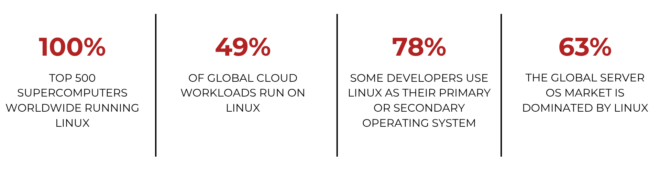
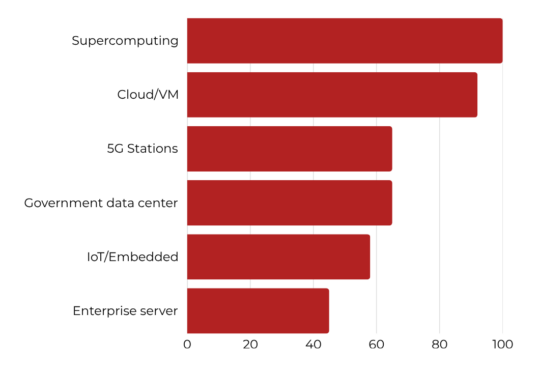
One of Linux’s most tangible strengths is its operational stability. Linux systems can run for years without forced reboots, without unplanned updates interrupting workflows, and without the surprises proprietary operating systems can sometimes introduce. In the server world, this is almost taken for granted: it is no coincidence that 92% of virtual machines on AWS, Google Cloud, and Microsoft Azure run on Linux.
But stability is not only about servers. For professional workstations where operational continuity is critical (data acquisition systems, NAS storage, monitoring environments) Linux drastically reduces the risks associated with unexpected downtime.
“We can no longer accept not having full control over our data and digital infrastructures.”
David Amiel, French Minister for the Budget — April 2026
Linux is structurally more resistant to malware than mainstream operating systems for several architectural reasons: its user permission model, the absence of a vulnerable centralized system registry, and the transparency of open-source code, which allows continuous audits by the global community.
This does not mean Linux is invulnerable, no system is. But it does mean the attack surface is significantly reduced. In environments where data protection is a priority, that difference matters.
Linux is well known for its ability to extract optimal performance from available hardware. On machines with limited resources, or on professional hardware that must be utilized to its fullest potential, Linux enables highly customized configurations without unnecessary overhead or unwanted background processes.
Learn more about our solution, which can also be installed on Linux!
This translates into faster response times, lower hardware requirements for the same level of performance, and much more granular resource management. For critical applications such as storage and surveillance systems, these margins make a real difference.
The migration to Linux is not a niche phenomenon. Some of the world’s most important institutions have already made this transition, with documented results.
In April 2026, DINUM (Direction Interministérielle du Numérique) ordered the migration of all government workstations to Linux. The model is the Gendarmerie Nationale, which has been using GendBuntu on more than 103,000 workstations since 2008, with estimated savings of €2 million per year.
The German state has completed nearly 80% of its migration from Microsoft to Linux and LibreOffice, with documented savings of €15 million. The project has become a model for the federal OpenDesk initiative.
Migration from Microsoft to open-source platforms was announced in 2025 as part of a national digital sovereignty strategy.
In 2025, France’s third-largest city launched the migration from Microsoft Office and Windows to Linux and OnlyOffice for all municipal employees as part of the “Open Digital Territory” project. Local digital sovereignty and GDPR compliance were among the main motivations.
India’s Ministry of Defence has begun replacing Windows desktops with Linux across tens of thousands of locations, involving millions of users. It is one of the largest government migration projects ever announced in terms of demographic scale.
In 2024, the European Commission ruled that Microsoft 365 violates GDPR regulations, forcing a gradual discontinuation of its use and the adoption of open-source solutions. A powerful political signal for public administrations across Europe.
The U.S. Department of Defense and NASA have relied on Linux and open-source technologies in mission-critical environments for years, explicitly citing stronger security and better cost efficiency compared to proprietary alternatives.
AWS, Google Cloud, and Microsoft Azure all rely heavily on Linux. Even Microsoft’s own cloud infrastructure runs approximately 61.8% on Linux machines, while Google Cloud reaches 91.6%. That is not a coincidence.
uSS is compatible with Linux, Windows, and macOS. But on Linux, it expresses its full potential: lower system overhead, greater stability, and optimized hardware resource management. For installations running 24/7 (continuous surveillance, persistent storage, monitoring environments), the combination of uSS and Linux is a choice that pays off over time.
This is not about abandoning what already works. It is about consciously choosing the platform best suited to long-term goals: resilience, security, and optimization. On all three fronts, Linux has proven itself in some of the most demanding environments in the world.



 Italian
 Spanish
 English